Sponsored article
Heated Rear Windshield with Antenna: What Changes During Replacement?
- Why Rear Windscreens Are Made from Tempered Glass
- How Tempered Glass Behaves When Broken
- How Heating Elements Work Through Electrical Resistance
- The Dual Function of the Heating Grid as a Radio Antenna
- Verifying Technical Specifications Before Ordering a Replacement
- Classification of Rear Window Variants in Distribution Catalogues
- Why Electrical System Compatibility Matters
- FAQ
A rear windscreen serves several functions at once. It provides rearward visibility, acts as a safety component during collisions, and houses various electrical systems. Drivers rarely pay attention to these integrated features until they stop working. The glass contains circuits responsible for defrosting and radio signal reception. Because of this complexity, replacing a damaged rear windscreen requires careful verification of technical specifications. The technician must select the correct circuit layout and properly connect the vehicle’s electrical harnesses.
Read more: Why Consider Purchasing a Fuel Tank for Large Enterprises?
Why Rear Windscreens Are Made from Tempered Glass
Rear windows in passenger cars and commercial vehicles are almost exclusively manufactured from tempered safety glass, commonly referred to as ESG glass. The production process involves heating the glass to approximately 600-700°C and then rapidly cooling it with compressed air.
This thermal treatment creates controlled internal stresses that significantly increase the material’s mechanical strength.
As a result, tempered glass can be several times more resistant to impact and bending than conventional glass. This is particularly important because the rear section of a vehicle body constantly flexes and twists while driving. The rear windscreen must be capable of handling these stresses without compromising safety.
This construction differs fundamentally from laminated windscreens used at the front of the vehicle, which consist of two layers of glass bonded together with a PVB interlayer.
How Tempered Glass Behaves When Broken
When the stress resistance threshold is exceeded, the entire structure of tempered glass fails almost instantly.
After a significant impact, the glass loses its integrity and shatters into thousands of small, blunt-edged fragments within a fraction of a second.
This fragmentation pattern is a safety requirement because it reduces the risk of severe injuries during an accident. Unlike ordinary glass, tempered glass does not produce large, sharp shards.
The characteristic breakage pattern allows occupants to exit a damaged vehicle more easily without specialised cutting tools. Emergency responders can also remove the remaining fragments from seals and body openings more safely.
However, this behavior means that tempered rear glass cannot usually be repaired in the same way as laminated windscreens. Small cracks cannot be reliably stabilised with resin injection. In most cases, local damage requires the replacement of the entire component.
How Heating Elements Work Through Electrical Resistance
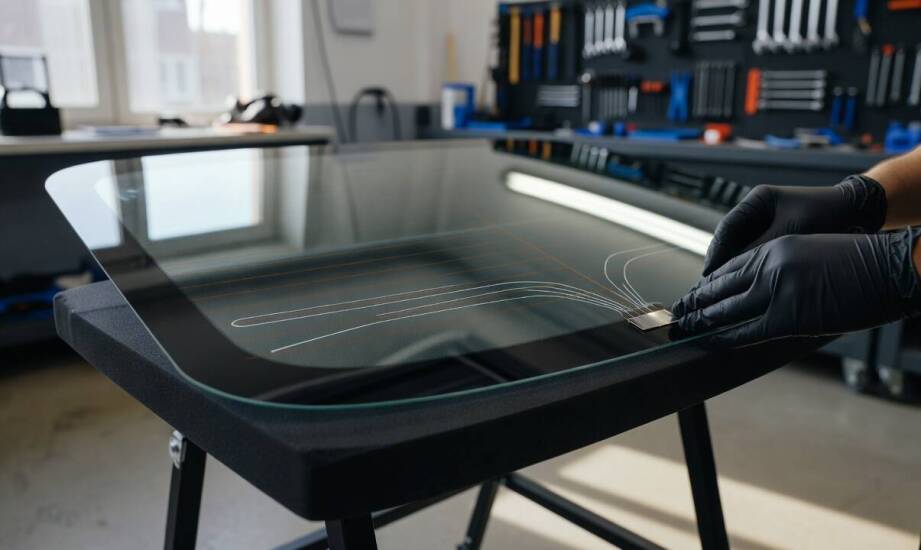
The thin horizontal lines visible on a rear windscreen are precisely applied conductive tracks. Manufacturers typically create them using silver-based compounds or nickel alloys.
The system operates through electrical resistance and the Joule heating effect. As electric current passes through the conductive tracks, heat is generated, which quickly raises the glass temperature and removes frost, ice, and condensation.
The heating grid requires a considerable amount of electrical power. For this reason, vehicle manufacturers use dedicated relays and timed control systems. The rear defroster often switches off automatically after several minutes to help protect the battery and the heating circuits themselves.
For proper operation, every conductive line must remain intact. A break in a single heating track interrupts the circuit and can leave visible bands of ice or fog on the glass surface.
The Dual Function of the Heating Grid as a Radio Antenna
Vehicle designers have long used the rear-window heating grid as a radio antenna, eliminating the need for exposed roof-mounted aerials.
The same conductors embedded in the glass can receive FM signals and, in some vehicles, AM signals as well. Because the heating system carries electrical current, factory-installed filters separate operating voltage from radio frequencies, protecting sensitive multimedia components.
Faults in this combined system can produce recognisable symptoms. Damaged circuits or corroded connectors often result in weaker radio reception, interference, or static noise, especially when the rear defroster is activated.
In newer vehicles, some of the upper lines in the grid may be completely separated from the heating system and dedicated solely to wireless communication functions.
Verifying Technical Specifications Before Ordering a Replacement
Selecting the correct replacement component requires a detailed analysis of the vehicle's equipment configuration.
Ordering a rear window based solely on the model year or body style often results in an incompatible part. The same vehicle model may have been produced with a standard heated rear window, a version with an integrated radio antenna, or an advanced variant supporting additional systems.
Differences may include connector layouts, wiring configurations, and mounting points for components such as the rear wiper assembly.
Installing the wrong version can prevent proper connection of factory wiring and may result in the loss of heating or multimedia functions after installation.
A professional installer should always verify the electrical layout before removing the damaged glass.
Classification of Rear Window Variants in Distribution Catalogues
Parts distributors use standardised cataloguing systems to identify the correct replacement component.
The international category rear windscreen glass helps technicians narrow search results specifically to rear windows equipped with the required functions while excluding incompatible components.
Supplier databases typically provide detailed information about integrated wiring layouts, signal connections, and heating systems.
An example is Windshields24, which aggregates technical specifications for automotive glass manufactured by brands such as AGC, Pilkington, and Saint-Gobain Sekurit. Reviewing product specifications and connector layouts helps ensure that the selected component is suitable for installation.
Why Electrical System Compatibility Matters
Restoring full vehicle functionality after a rear windscreen replacement requires attention to the entire electrical system, not only the glass dimensions.
The correct shape and size of the tempered glass are only part of the equation. Proper alignment of heating terminals, antenna connectors, and electrical contacts helps prevent later malfunctions.
Accurate integration of the heating grid restores the factory-designed defrosting cycles and ensures reliable visibility in challenging weather conditions.
Key Takeaways
A rear windscreen combines visibility, safety features, and integrated electrical systems.
Tempered glass improves impact resistance but shatters into small fragments when broken.
Heating elements defrost and demist the rear viewing area using electrical resistance.
In many vehicles, the same conductive lines also function as a radio antenna.
During replacement, heating systems, antenna functions, and connector layouts must all be verified.
Choosing the correct replacement depends on functional specifications, not only vehicle model information.
Matching dimensions alone is insufficient if heating and radio systems must continue operating correctly.
FAQ
How can I tell whether a rear windscreen has an integrated radio antenna?
Additional connectors, a specific layout of conductive lines, or dedicated signal terminals often indicate the presence of an integrated antenna. Verification should be based on the vehicle equipment specification and wiring diagrams, as visual inspection alone may not be enough.
Can damaged heating elements in a rear windscreen be repaired without replacement?
Usually not. While very small defects in conductive tracks can sometimes be addressed on a limited basis, a reliable long-term repair is often not possible. More significant damage generally requires complete replacement of the window.
Why might the radio perform worse after a rear windscreen replacement?
This often indicates an issue with the antenna integrated into the glass or the installation of an incorrect glass variant. Poor connector contact, corroded terminals, or incompatibility with the vehicle's original equipment can all affect radio reception quality.
You might be interested

What elements determine the high quality of pork meat?
Why Consider Purchasing a Fuel Tank for Large Enterprises?

What Are the Future Directions for Contract Manufacturing of Nutritional Supplements?